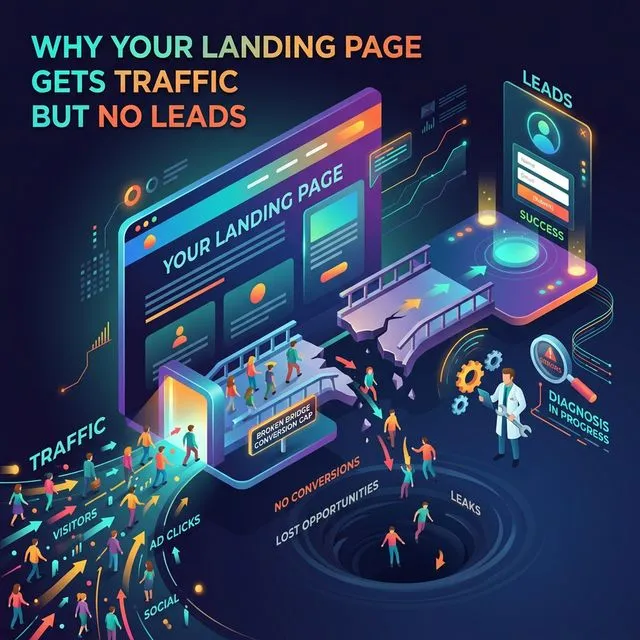
Landing page conversion problems have three root causes: technical failure, weak ad intent, or message mismatch. Diagnose by pairing LP-to-Lead Rate with CTR Ratio. A healthy LP-to-Lead Rate is 10% or above for lead gen. If CTR Ratio is above 0.60 but LP-to-Lead is low, the problem is message mismatch between the ad promise and the page delivery. If CTR Ratio is below 0.40, the ad is sending unqualified traffic. Check Click-to-LP Rate first to rule out technical issues.
You've spent money driving traffic. The clicks are coming in. People are landing on your page. But the leads... barely a trickle.
So you do what most business owners do. You rewrite the headline. Change the button color. Swap the hero image. Test a new offer. Maybe hire a copywriter to redo the whole thing.
And nothing moves.
We've seen this play out dozens of times across the accounts we manage at Talk To Your CMO. The business owner is convinced the landing page is broken. Sometimes it is. But based on our analysis, about half the time the page is actually fine. The problem started earlier in the funnel, and the landing page is just where it becomes visible.
The only way to know which situation you're in is to pair your landing page conversion rate with another metric. One number alone can't tell you. Two numbers paired together tell you exactly what's wrong.
The Metric: LP→Lead Rate
Landing page to lead rate (LP→Lead Rate) measures the percentage of people who see your landing page and take the action you want. Fill out a form, book a call, start a trial, make a purchase... whatever your conversion event is.
LP→Lead Rate = Leads / Landing Page Views
If 1,000 people see your page and 80 fill out the form, your LP→Lead Rate is 8%.
Here's where most advice stops. They'll say "8% is below average, improve your page." And that's where most business owners go wrong. Because 8% means very different things depending on WHO is landing on that page.
Why LP→Lead Rate Alone Is Misleading
Picture two ad sets. Both send traffic to the same landing page. Same page, same offer, same form.
Ad Set A: LP→Lead Rate is 7%
Ad Set B: LP→Lead Rate is 22%
Same page. Wildly different results. So the page isn't the problem... the traffic is.
This is why you need to pair LP→Lead Rate with CTR Ratio. CTR Ratio tells you whether the people clicking your ad have real intent or are just browsing. When you combine the two, the diagnosis becomes clear.
The Paired Diagnosis
| LP→Lead Rate | CTR Ratio | What's Actually Happening |
|---|---|---|
| Below 10% | Above 0.60 | Message mismatch. People click with intent (they want what the ad promised) but the page doesn't deliver on that promise. Fix the page. |
| Below 10% | Below 0.40 | Double problem. The ad attracts low-intent traffic AND the page doesn't convert. Start with the ad. |
| 10% to 20% | Any | Normal range. Decent performance. Optimize, don't overhaul. |
| Above 20% | Above 0.60 | Strong alignment. The ad and page tell the same story. Scale this. |
| Above 20% | Below 0.40 | The page is carrying the ad. Conversions are happening despite weak ad intent. Imagine what happens if you improve the ad creative. |
That table is the diagnostic we developed at Talk To Your CMO and run on every account. Two minutes to check. And it saves business owners from spending weeks fixing the wrong thing.
Message Mismatch: The Most Common Problem
High CTR Ratio + low LP→Lead Rate. This is the pattern I see most often.
It means your ad is clear enough that people click with intent. They understand the offer, they're interested, they tap through. So far so good.
Then they hit the landing page and something breaks. The story changes. The tone shifts. The offer feels different. The next step isn't obvious.
Here's what message mismatch looks like in practice:
Ad says "Get a free marketing audit." Page leads with a 2,000-word essay about why marketing audits matter. The visitor wanted the audit, not a lecture.
Ad highlights "Save 30% this month." Page doesn't mention the discount above the fold. Visitor has to scroll to find it. Most don't.
Ad uses casual, direct language. Page switches to corporate-speak. Feels like a different company.
Ad promises speed ("Results in 48 hours"). Page talks about a "comprehensive 6-week onboarding process." Immediate disconnect.
The fix for message mismatch is straightforward. Make the first thing people see on your landing page match exactly what the ad promised. Same language. Same offer. Same energy. The transition from ad to page should feel like one continuous conversation.
Gary Halbert called this "message to market match." The principle hasn't changed in 40 years. The ad makes a promise, the page delivers on that promise immediately.
The Double Problem
Low CTR Ratio + low LP→Lead Rate. This one is tougher because it means two things are broken at once.
The ad is attracting curiosity clicks instead of intent clicks (people engage with the content but don't click through with purpose). And the page doesn't convert the traffic it does get.
When this happens, start with the ad. Here's why: fixing the page is pointless if you're sending the wrong people to it. You could build the best landing page in the world and it won't convert someone who never intended to buy.
Get the CTR Ratio above 0.60 first. Then see what LP→Lead looks like with higher-intent traffic. Often the page performs fine once the right people are arriving.
Before You Touch the Page: Rule Out Technical Issues
One more thing. Before you diagnose message mismatch or audience quality, check your Click to Landing Page Rate first.
If less than 50% of your link clicks result in a landing page view, the problem is technical. Slow page speed, broken redirects, tracking issues. People literally aren't seeing your page.
That's always Step 1 in the full diagnostic framework. Technical delivery first. Then intent quality. Then message match.
If you skip that order, you'll waste time fixing a page that nobody's seeing in the first place.
What to Do Right Now
Open your ad dashboard and pick the ad set that's getting traffic but not converting.
- Check Click→LP Rate. If it's below 50%, stop here and fix the technical issue first.
- If Click→LP is healthy, check your LP→Lead Rate. Below 10% means something is off.
- Now check CTR Ratio for that same ad set. Above 0.60 with low LP→Lead means message mismatch. Below 0.40 means your ad needs work first.
- If it's message mismatch, compare your ad copy side-by-side with your landing page headline and first paragraph. Do they tell the same story? If the answer is no, that's your fix.
Four steps. Takes about five minutes. And it tells you whether to fix the ad, fix the page, fix the tech, or scale what's working.
Most businesses never do this. They assume low conversions means "bad page" and start testing random changes. Now you know how to diagnose the real problem first.
Frequently Asked Questions
What is a good landing page conversion rate for lead generation?
A LP-to-Lead Rate of 10% to 20% is normal for most lead gen campaigns. Above 20% with a CTR Ratio above 0.60 means strong alignment between the ad and the page. Below 10% signals a problem, but the fix depends on whether CTR Ratio is high (message mismatch) or low (wrong traffic). Industry benchmarks are less useful than comparing across your own ad sets on the same page.
How do I tell if the problem is my ad or my landing page?
Check CTR Ratio alongside LP-to-Lead Rate. If CTR Ratio is above 0.60 but LP-to-Lead is below 10%, the ad is doing its job bringing intent traffic -- the page is failing to convert. If CTR Ratio is below 0.40, the ad is sending low-quality traffic and fixing the page will not help until the ad improves.
What is message mismatch and how do I fix it?
Message mismatch happens when your ad promises one thing and the landing page delivers something different. Common examples include an ad offering a free audit that leads to a page full of educational content, or casual ad copy that lands on a corporate-tone page. Fix it by making the first thing visitors see on the page match the exact language and offer from the ad. Same words, same energy, same promise.
Should I A/B test my landing page if conversions are low?
Only after you have diagnosed the actual problem using paired metrics. If your CTR Ratio is below 0.40, A/B testing the page is a waste of time because the traffic itself is low-intent. If Click-to-LP Rate is below 50%, the page has a technical problem that testing will not solve. A/B testing is useful when you have confirmed message mismatch -- high CTR Ratio, healthy Click-to-LP, and low LP-to-Lead Rate.
What should I check before rewriting my landing page?
Run the 3-step diagnostic first. Check Click-to-LP Rate (below 50% means a technical problem, not a copy problem). Then check LP-to-Lead Rate paired with CTR Ratio to identify whether the issue is message mismatch or bad traffic. About half the time I audit accounts with "bad landing pages," the page is actually fine and the problem started earlier in the funnel.
Landing page getting traffic but no leads? Book a free strategy call and we'll run the 4-step diagnosis on your funnel. Takes five minutes to find out whether the problem is the ad, the page, or the tech.