
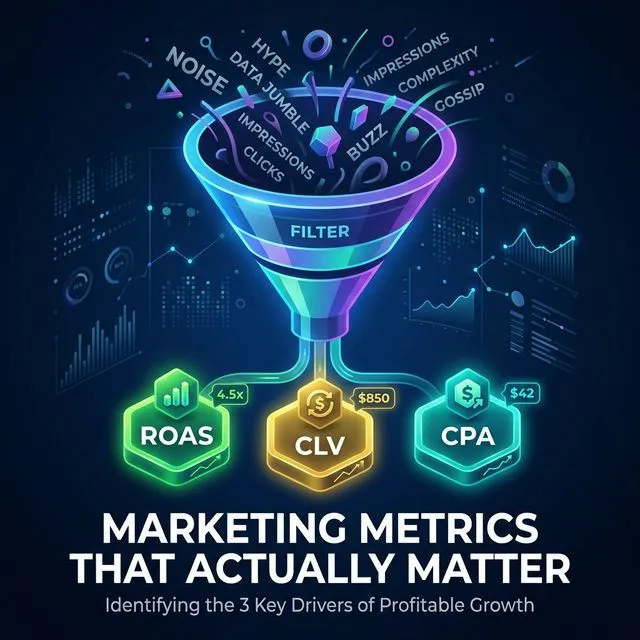
Four marketing metrics drive profitability: Customer Acquisition Cost (CAC), Customer Lifetime Value (CLTV), true ROI (net profit from marketing divided by marketing cost), and Payback Period (months to recover CAC). A healthy business maintains a CLTV-to-CAC ratio of 3:1 or higher and recovers acquisition costs within 6 months. Everything else in a marketing report -- impressions, reach, engagement rate -- is a vanity metric until these four numbers are healthy.
Most marketing reports are useless.
They're filled with numbers that look impressive but don't tell you anything about whether you're actually making money. Impressions, reach, engagement rate... these metrics make great slide decks but terrible business decisions.
After 10+ years of helping 7-8 figure businesses turn their marketing into profit centers, and based on what we see consistently in the accounts we manage at Talk To Your CMO, I've learned which metrics actually matter. Here's the framework we use with every client.
The Problem With Vanity Metrics
Here's a scenario I see constantly:
Your marketing team shows up to the monthly meeting with a beautiful report. CTR is up 15%. Reach increased by 200,000. Engagement is "crushing it."
Then you ask the question they dread: "How much money did we make?"
Silence.
The truth is, most marketing teams track what's easy to measure, not what matters. They optimize for metrics that make them look good instead of metrics that make you profitable.
The Metrics That Actually Matter
1. Customer Acquisition Cost (CAC)
This is the total cost to acquire one customer. Not a lead. Not a click. A paying customer.
Formula: Total Marketing Spend / Number of New Customers
If you spend $10,000 on marketing and get 50 new customers, your CAC is $200.
The key insight here is that CAC must be measured against Customer Lifetime Value (CLTV). If your average customer is worth $2,000 over their lifetime, a $200 CAC is excellent. If they're only worth $150, you're losing money on every sale.
2. Customer Lifetime Value (CLTV)
How much is a customer worth over their entire relationship with you?
This includes:
- Initial purchase
- Repeat purchases
- Referrals they generate
- Minus the cost to serve them
Most businesses underestimate CLTV because they only look at the first transaction. A customer who buys a $50 product might come back 10 times over 3 years and refer 3 friends. That's not a $50 customer - that's potentially a $800+ customer.
3. ROAS vs. True ROI
ROAS (Return on Ad Spend) is what Facebook tells you. True ROI is what your bank account shows.
The problem? They're often wildly different.
Facebook might say you got a 4x ROAS. But when you factor in:
- Cost of goods sold
- Shipping and fulfillment
- Customer service
- Returns and refunds
- Payment processing fees
That "4x ROAS" might actually be a 1.5x true return. Or worse, you might be losing money while Facebook tells you you're winning. Understanding what a good ROAS actually means for your margins is the first step to seeing through the dashboard number.
Always calculate true ROI, not platform-reported ROAS.
4. Payback Period
How long does it take to recover your customer acquisition cost?
If you spend $200 to acquire a customer and they pay you $50/month, your payback period is 4 months.
This matters for cash flow. A business with a 4-month payback period can reinvest profits quickly. A business with a 12-month payback period needs much more capital to grow.
How to Start Tracking What Matters
Set up proper attribution. You need to know which marketing efforts are actually driving sales, not just clicks.
Connect your ad data to your revenue data. This is where tools like Shido come in - they bridge the gap between what Facebook says and what your bank account shows.
Calculate your numbers monthly. CAC, CLTV, and payback period should be on your executive dashboard, not buried in spreadsheets.
Make decisions based on profitability, not activity. A campaign with lower reach but higher ROI is always better than the reverse.
The Bottom Line
Your marketing team should be accountable for revenue, not just activity. If your reports don't answer "how much money did we make?", you're tracking the wrong things.
Start with CAC, CLTV, true ROI, and payback period. These four metrics will tell you more about your marketing health than a hundred pages of engagement reports. And if you want to go deeper into your ad dashboard specifically, here's how to read your ad dashboard without being a marketer.
Want to know your real CAC, CLTV, and payback period? Book a free strategy call and we'll calculate the four metrics that actually tell you whether your marketing is making money.
Frequently Asked Questions
What is a good Customer Acquisition Cost (CAC)?
A good CAC depends on your Customer Lifetime Value (CLTV). The benchmark is a CLTV-to-CAC ratio of 3:1 or higher. So if your average customer is worth $2,000 over their lifetime, a CAC of $600 or less is healthy. If your CAC is higher than your CLTV, you're losing money on every customer you acquire.
How do I calculate Customer Lifetime Value if I don't have years of data?
Start with what you have. Take your average order value, multiply it by average purchase frequency per year, then multiply by average customer lifespan in years. Even a 12-month lookback gives you a working number. Most businesses underestimate CLTV because they only count the first transaction and miss repeat purchases, upsells, and referrals.
What is the difference between ROAS and true ROI?
ROAS (Return on Ad Spend) is revenue divided by ad spend -- it's the number your ad platform reports. True ROI factors in cost of goods sold, shipping, fulfillment, customer service, returns, and processing fees. A 4x ROAS can easily become a 1.5x true return or even a loss once you account for all costs. Always calculate true ROI before making budget decisions.
What payback period should I aim for?
A payback period under 6 months is strong for most businesses. If you spend $200 to acquire a customer who pays $50/month, your payback period is 4 months -- that's healthy cash flow. Anything over 12 months means you need significant capital reserves to sustain growth, and you should look at ways to increase initial purchase value or reduce acquisition cost.
Why are impressions and engagement considered vanity metrics?
Impressions, reach, and engagement rate measure activity, not profitability. You can have a million impressions and still lose money. These metrics only become meaningful once your CAC, CLTV, true ROI, and payback period are healthy. Until then, they're distractions that make reports look good while hiding whether the business is actually making money from marketing.