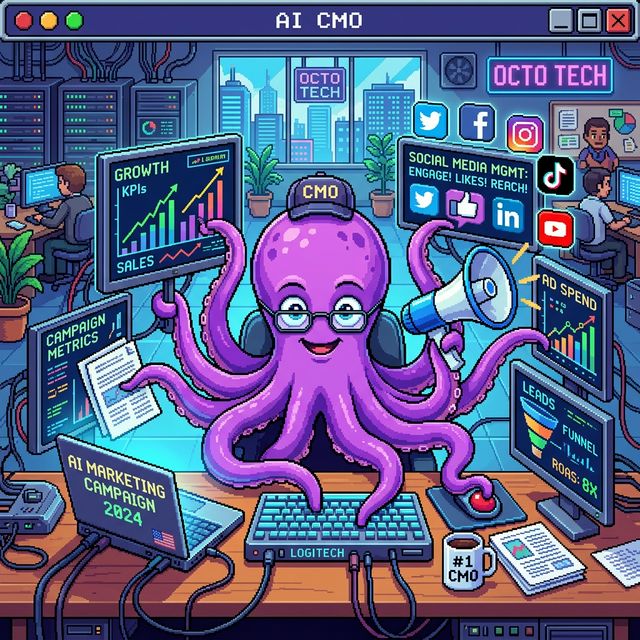
An AI CMO is an artificial intelligence system installed into a business to handle the strategic marketing work that used to require a $250,000+ executive hire. It analyses ads, SEO, funnels, email, and social media. Then it gives your team direct action plans, writes copy, and runs outreach. Always on. Never sleeps. And it costs a fraction of what a full-time CMO would run you.
I used to do all my marketing manually.
Content planning. Figuring out what to post. Checking what's working. Researching keywords. Writing drafts. Scheduling. Reviewing analytics. Repeat.
Every week, the same cycle. And I'm someone who's managed ad accounts and marketing strategy for years. I know what to look for. I know what metrics matter. But there's only so many hours in a day.
So I built an AI CMO for myself.
And the shift was immediate. I went from doing all the thinking to just approving the output. My content impressions grew by 301.3%. Engagement grew by 466.7%. And I didn't work harder. I worked less.
That's when I realized... most business owners running $15K to $150K a month in revenue are flying completely blind on marketing. They can't justify a $250K marketing hire. They can't find a good fractional CMO. So they either wing it, hand everything to an agency that sends them reports they don't understand, or just ignore marketing altogether.
There's a better option now.
What an AI CMO Actually Does
Think of an AI CMO like having a full marketing team at your fingertips. You send a message and the whole team starts working. They come back with results. On certain days at certain times, they know what to do without any prompts. And best of all, they self-improve.
Here's what a typical Monday morning looks like with an AI CMO installed:
The system checks Google Search Console to find what happened last week
It looks up keyword data to find new search terms worth targeting
It drafts blog topics based on real search demand, not guesses
It pulls your social media page's content report and plans the week's content
Your team receives finished drafts to approve
That's it. Your team reviews and approves. Most of the time, you only heavily edit the first few pieces. After that, the AI learns your business's voice and tone. The team barely edits anymore.
It Analyses Everything. Constantly.
A human CMO checks your marketing once a week during a status meeting. Maybe. An AI CMO is looking at your SEO performance, ad metrics, funnel data, email open rates, and social engagement all the time. Every day. Without being asked.
When something changes... a keyword ranking drops, a landing page stops converting, ad costs spike... the AI CMO catches it while it's small. Before it becomes expensive.
It Gives Your Team Action Plans
Most marketing tools give you dashboards. Charts. Graphs. Numbers that look important but don't tell you what to DO.
An AI CMO skips the dashboard and goes straight to the action. Instead of "your CTR dropped 15%," you get "your CTR dropped 15% on these 3 ad sets. Here's why, and here's exactly what to change."
I wrote about how to tell if your ads are actually working using paired metrics. A human has to sit down and do that analysis manually. An AI CMO does it automatically, every day, across every ad set. And it hands your team the diagnosis plus the fix.
Your team doesn't need to interpret data. They just need to execute the plan.
It Executes
This is where it gets interesting. An AI CMO doesn't just analyse and recommend. It writes the blog posts. It drafts the social content. It builds the email sequences. It plans the outreach.
You see, the old model was: hire a strategist to think, then hire a team to do. An AI CMO does both. The strategy and the execution happen in the same system.
The $250K Problem
A full-time CMO in the U.S. costs somewhere between $250,000 and $800,000 a year when you add salary, benefits, bonuses, and equity. The median sits around $373,000. The 90th percentile is $455,000.
For a business doing $2M to $10M in revenue, that math just doesn't work. You can't hand 10-20% of your revenue to one person and hope they figure it out.
And even if you could afford it, good luck finding one. The average CMO tenure is about 4.2 years. Half the time you're onboarding them, and the other half they're already looking at their next move. So you're paying a quarter million a year for someone who's fully dialed in maybe 50% of the time they're with you.
Most businesses end up in one of two traps.
They hire an agency. The agency sends reports full of metrics that look impressive but don't tell you anything. The business owner doesn't understand the reports. Nobody makes strategic decisions. Marketing becomes a cost center instead of a growth engine.
Or they hire a fractional CMO at $6,000 to $15,000 a month. Better. But you get 10-20 hours a week. Maybe. And here's the real question... is that fractional CMO using AI themselves? Most of them haven't even started. Some still believe in doing everything manually.
The game has changed. AI agents can now handle 80% of the strategic marketing work that used to require a senior hire. The remaining 20% is orchestration, real-life stories, and human judgment. You still need a person. You just don't need them 40 hours a week at $250K a year.
AI CMO vs Fractional CMO vs Full-Time CMO
Here's the honest breakdown:
| Full-Time CMO | Fractional CMO | AI CMO | |
|---|---|---|---|
| Annual cost | $250K-$800K | $72K-$180K | Under $50K |
| Hours per week | 40+ | 10-20 | Always on |
| Time to onboard | 4-6 months | 2-4 weeks | Days |
| Covers strategy | Yes | Yes | Yes |
| Covers execution | Delegates to team | Sometimes | Yes |
| Learns your voice | Over months | Over weeks | Over days |
| Available at 2 AM | No | No | Yes |
| Scales with you | Slowly | Somewhat | Instantly |
The full-time CMO makes sense when you're past $20M in revenue, you have a 10+ person marketing team, and you need someone in the room for board meetings and investor calls.
The fractional CMO makes sense when you need strategic direction and you have a team that can execute. But the value drops fast if the fractional isn't AI-literate. You're paying premium rates for someone who's manually doing work that AI handles in minutes.
The AI CMO makes sense for the business in between. You're doing $15K to $150K a month in revenue. You need marketing leadership but you can't justify a C-suite salary. You want strategy AND execution. And you want it running every single day, not just during a weekly check-in.
How an AI CMO Gets Installed Into a Business
This isn't a software login. You don't sign up, click around a dashboard, and hope for the best. An AI CMO is installed. Configured for your business. Connected to your data. Trained on your voice.
Week 1: Audit and Foundation
The first step is understanding where you are. The AI CMO connects to your existing tools... Google Search Console, ad platforms, email systems, social accounts. It pulls in your current data and builds a baseline.
At the same time, it studies your brand. Your past content. Your tone. Your audience. The way you talk about your business.
By the end of week 1, it knows your marketing landscape better than most agency account managers would after a month.
Week 2: Agent Deployment
Now the AI agents start working. Content agents draft blog posts and social media content based on real keyword data and your content calendar. Analytics agents monitor your ad performance and SEO rankings. Outreach agents plan email sequences and follow-ups.
This is the week where it starts feeling like you have a team. You send a message and the whole system responds.
Week 3 and Beyond: Autonomous Operation
Here's where it compounds. The AI CMO has learned your voice. It knows what content performs well. It knows which keywords to target. It knows your audience's patterns.
You go from reviewing everything to reviewing almost nothing. The system operates on its own. You feed it real-life updates... what's happening in your business, new client wins, industry changes... and it turns those into content and strategy.
The feedback cycle gets faster every week. And the AI gets better every week. That's the part most people miss. This isn't a static tool. It self-improves.
I've been through this cycle myself. The first couple weeks, I was editing almost every draft. By week 3, the AI was matching my voice so closely that I'd read a post and forget I didn't write it. The metrics that actually matter started moving in the right direction. Not because I was working more. Because the system was getting smarter.
Can AI Actually Replace a CMO?
Let me be direct about this. An AI CMO handles:
Data analysis and pattern recognition
Content creation and scheduling
SEO research and keyword targeting
Ad performance monitoring
Social media planning and drafting
Email sequence building
Weekly and monthly reporting
What it still needs a human for:
Orchestrating the system and setting direction
Feeding it real-life experiences and stories
Case studies and client relationships
Scouting new tools and channels to plug in
High-stakes strategic decisions
The AI CMO is awesome. But it will never know what happens in the life of a person. It doesn't know you just closed a big deal. It doesn't know you had a conversation with a customer that changed how you think about your market. It doesn't know you found a new tool that could change your workflow.
So the honest answer is: AI replaces about 80% of what a CMO does. The other 20% is the human layer. And that 20% is actually the most important part... it's just that it doesn't take 40 hours a week anymore.
You need someone to orchestrate the AI CMO properly. Make sure the feedback cycle is fast. Feed it real stories and real data. The AI does the heavy lifting. The human provides the direction and the lived experience.
Why This Is Happening Now
Two years ago, this wasn't possible. AI tools could write a blog post if you gave them a detailed prompt. But they couldn't strategize. They couldn't connect to your data sources. They couldn't coordinate across channels. They were fancy autocomplete.
In 2025 and 2026, something shifted. AI agents became capable of autonomous multi-step work. They can check your analytics, identify a problem, draft a solution, and execute it. All without a human babysitting the process.
McKinsey found that 42% of organizations are now using AI in sales and marketing. Gartner projects that by 2028, 90% of B2B buying will be intermediated by AI agents. The businesses that install AI marketing leadership now are building a compounding advantage. The ones that wait are going to be playing catch-up against competitors whose AI has been learning their market for two years.
This is where the market is heading. The only question is whether you ride the wave or get hit by it.
Who This Is For (And Who It Isn't)
An AI CMO works best for:
Businesses doing $15K to $150K per month in revenue
Founders and operators who are currently "winging it" on marketing
Companies that tried an agency and felt like they were just paying for reports
Teams that want marketing leadership without a C-suite salary
An AI CMO probably isn't right for:
Pre-revenue startups that haven't found product-market fit yet
Enterprise companies with 50+ person marketing departments
Businesses that need someone in the room for investor meetings and board presentations
If you're in that middle ground... past the scrappy startup phase but not yet big enough for a full marketing department... this is built for you.
Frequently Asked Questions
How much does an AI CMO cost?
An AI CMO costs significantly less than a traditional hire. A full-time CMO runs $250K-$800K per year. A fractional CMO runs $72K-$180K. An AI CMO system can be installed and operated for under $50K annually, and that includes both the strategy and execution layer.
How long does installation take?
Most AI CMO installations are up and running within 1-2 weeks. By week 3, the system is operating semi-autonomously. Compare that to 4-6 months to hire and onboard a full-time CMO.
Do I need technical skills to work with an AI CMO?
No. The whole point is that the AI CMO does the technical work. You review content, approve plans, and feed the system with real-life business updates. If you can send a message, you can work with an AI CMO.
How is an AI CMO different from marketing automation?
Marketing automation handles repetitive tasks... sending emails, posting scheduled content, triggering workflows. An AI CMO does strategy. It decides WHAT to post, WHEN to post it, and WHY. It analyses performance and adjusts the plan. Automation follows rules. An AI CMO makes the rules.
Will an AI CMO work for my specific industry?
AI CMO systems are trained on your specific business, voice, and audience during installation. They work across industries because they learn YOUR patterns and YOUR market. The system adapts to you, not the other way around.
Marketing leadership used to require a massive salary or a lucky hire. That's just not the case anymore.
Once you have an AI CMO installed, marketing becomes something that happens every day in your business without you being the bottleneck. Your content gets planned. Your SEO gets monitored. Your ads get diagnosed. Your team gets action plans.
And you get to focus on running your business.
If you want to see how an AI CMO would work for your specific situation, book a strategy call and I'll walk you through it.