
The best AI marketing agents for small businesses in 2026 include HubSpot Breeze, Jasper, Lindy, Gumloop, and Salesforce Agentforce. Most run between $29 and $800+ per month. Some have free tiers. They handle content creation, email automation, ad copy, social scheduling, and campaign management. Every "Top 10" list you find online is written by one of these companies, ranking their own product first. Funny how that works. This article reviews the actual tools and covers an alternative that most reviews skip entirely: owning your own AI agent instead of renting someone else's.
What AI Marketing Agents Actually Do
I have been running paid ads and marketing campaigns for over 10 years. I have tested more tools than I can count. Most of them promise to save you time and end up creating a second job managing the tool itself. That pattern has not changed with AI. It has just gotten more expensive.
So first, some clarity. The term "AI marketing agent" gets thrown around loosely. There are three distinct things being sold under that label.
Think of it like hiring help. An AI-assisted tool is like giving your employee a calculator. An automation platform is like giving them a checklist they follow every time. A true AI agent is like hiring someone who can think and figure out the next step without you spelling it out.
AI-assisted tools. These add AI features to an existing platform. Mailchimp's AI subject line generator, Canva's Magic Write, HubSpot's content assistant. You still do most of the work. The AI handles pieces of it. These have been around for a while.
AI automation platforms. These connect multiple tools and run workflows automatically. Zapier, Make, ActiveCampaign. You set up the rules. The system follows them. Smart, but still rules-based. If the situation changes, the automation keeps doing the old thing until you update it.
True AI agents. These are given a goal and figure out how to achieve it. They reason through options, adapt when things change, and coordinate across platforms without you updating every rule. Salesforce Agentforce and Gumloop are closer to this end. Most "AI marketing agents" on the market today are really just the first two categories with better branding.
That distinction matters. Right? Most of what you will find is automation dressed up in agent clothing. Knowing the difference saves you from paying for something that does not match what you expected.
The Tools Worth Looking At
Here is what is actually out there right now. I am including real pricing, what each tool does well, and where it falls short.
HubSpot Breeze AI
HubSpot built three AI agents directly into their platform: a Content Agent, a Social Agent, and a Prospecting Agent. They sit inside the CRM, so they have access to your contact data, deal history, and engagement patterns.
The Content Agent drafts blog posts and landing pages using your brand voice. The Social Agent creates and schedules social content. The Prospecting Agent researches companies and writes personalized outreach.
Pricing: Marketing Hub Professional starts around $800/month. The AI features come included with paid plans.
The take: Powerful if you are already on HubSpot. The AI agents work because they sit on top of your CRM data, so they actually know who your contacts are and what they have done. But $800+/month is a steep entry point for a small business. That is a lot of money to find out if AI marketing works for you. And if you are not on HubSpot, moving your entire stack just for the AI features rarely makes sense.
Jasper
Jasper started as an AI copywriting tool and grew into a full content platform. Their Content Pipelines feature connects research, writing, and distribution into one automated flow. They have 100+ specialized marketing workflows for different tasks.
The Brand IQ engine learns your voice and applies it across everything. Campaign workflows let you generate a blog post, social posts, and email announcements from one description.
Pricing: From $59/month (billed annually). Enterprise plans go higher.
The take: Strong for content-heavy teams that need volume. If your bottleneck is producing enough written content, Jasper handles that well. If your bottleneck is strategy, targeting, or knowing what to write about... Jasper will just help you produce more of the wrong thing faster.
Lindy
Lindy is a no-code agent builder with 4,000+ integrations. You build agents that handle email triage, lead routing, CRM updates, scheduling, follow-ups. Each agent can share information with other agents, so they work together as a team.
Pricing: Free tier available. Paid plans scale with usage.
The take: Flexible and genuinely useful for operations-heavy teams. But "no-code" still means you need to design workflows, test them, and maintain them. You still build the solution on top of it. Small businesses without someone technical or operations-minded will hit a wall.
Gumloop
Visual workflow builder for AI agents. You drag and drop components to create automated workflows. It has built-in access to the latest AI models, so no separate API keys. The web scraping and data collection is strong. And agents can run continuously and act on new data in real time.
Pricing: Free to start. Usage-based pricing after that.
The take: Genuinely powerful for technical users or anyone comfortable building workflows visually. The continuous agent feature is legitimately useful for monitoring and real-time tasks. But the learning curve is real. This is a builder's tool. Expect to spend time constructing before it pays off.
Salesforce Agentforce
Enterprise-grade AI agents that sit inside the Salesforce ecosystem. Native CRM integration means the agents have full access to your customer data, deal history, and interaction records. They handle campaign performance, lead scoring, and personalized outreach at scale.
Pricing: Enterprise pricing (custom quotes). Not cheap.
The take: Overkill for most small businesses. Designed for companies with dedicated marketing operations teams and complex multi-channel campaigns. If you are running a 10-person company, this is not built for you. If you are running a 200-person company, it is worth looking at.
Blaze AI
Multi-channel content platform that plans your content calendar, creates the assets, and handles posting across platforms. Positions itself as an agency alternative for teams that need consistent content output without the headcount.
Pricing: Custom (schedule a call for quotes).
The take: Good for maintaining a consistent social and content presence without dedicating a full-time person to it. Less depth per channel compared to specialized tools. Works best as a baseline content engine. You still need strategy on top of it.
ActiveCampaign
Email marketing and CRM with AI-powered automation. It adjusts delivery times per recipient. It scores your leads by win probability so you know who to focus on. The automation builder is rules-based but sophisticated enough to handle complex sequences.
Pricing: From roughly $29/month.
The take: Solid for email-focused businesses. The automation is well-built and reliable. But calling it an "AI marketing agent" is a stretch. It does what you tell it to do. It does not think. That is automation, not agency.
Sintra AI
Positions its agents as "Virtual Employees" for specific marketing roles. SEO agent, social media agent, customer support agent. Each one handles a defined function. The Brain AI feature aligns outputs with your brand voice and past data.
Pricing: From $39/month.
The take: Interesting concept, relatively new. The role-based approach makes it easier to understand what you are getting compared to generic "AI agents." Limited track record compared to the established players. Worth watching, too early to go all-in.
The Pattern Nobody Talks About
Look at the top search results for "best AI marketing agents" right now. Here is what you will find.
Tofu's article ranks Tofu as the top pick. NoimosAI's article ranks NoimosAI first. Averi's article puts Averi at number one. Heyy's article leads with Heyy. eesel AI's review highlights eesel AI.
So every single "Top 10" list is written by a company selling one of the tools on the list. And they always rank themselves first.
I would not call it deceptive. They believe in their product. They should. But you should know who is paying for the article before you trust its ranking. When a SaaS company publishes a "Best AI Marketing Agents" article, the article exists to sell their product. The review format is the vehicle.
This article is no different in one way. I have a service too. The difference is I am telling you upfront instead of pretending this is an objective industry review. And I am going to tell you about something that none of those lists mention at all.
The Alternative Most Reviews Skip
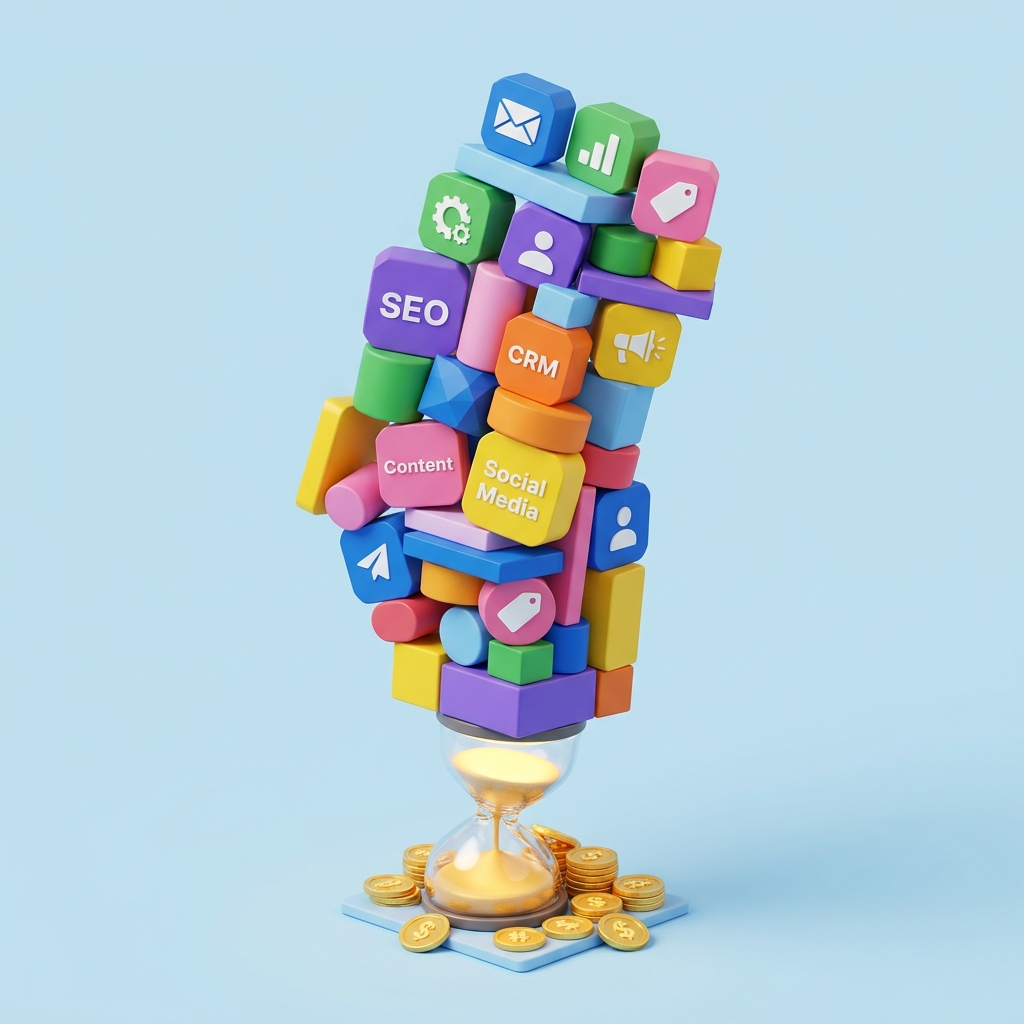
Every tool listed above solves a piece of the marketing puzzle. Content sits here. Email lives there. Social runs over there. And CRM is somewhere else.
So what happens when a small business tries to cover all the bases...
Jasper for content ($59/month). Surfer SEO for on-page scoring ($79/month). Mailchimp for email ($13/month). A social scheduler ($29/month). An analytics tool ($49/month). A chatbot ($29/month). Maybe a CRM with AI features ($50+/month).
That is $308/month minimum. $3,696/year. And that is before you factor in the time spent learning each tool, connecting them to each other, and maintaining the workflows between them. We broke down the real cost of stacking these subscriptions in a separate article. That time is usually 10-15 hours a month that none of those subscription prices account for. At even $50/hour of your time, that is another $500-$750/month that never shows up on the invoice.
Most small businesses end up using 30% of each tool's features because there are too many dashboards to manage. You are paying full price for five tools and getting the equivalent of one and a half.
There is another model that none of the listicle articles mention.
Instead of subscribing to five or six AI tools that each handle one slice of your marketing, some businesses are building or having someone install a single AI agent that handles the full stack. One agent that connects to your CRM, your ad accounts, your email platform, your analytics, and your content pipeline. It coordinates across all of them because it was built as one system. Not five tools duct-taped together with Zapier and a prayer.
I run one of these myself. One AI agent handles my content calendar, SEO research, lead outreach, ad monitoring, and analytics. It coordinates across platforms because it was built as one system. I do not log into six dashboards. I check one.
You own it. No monthly subscription per tool. No feature gates. No vendor lock-in. When you want to change how something works, you change it. When a new AI model comes out that is better, you swap it in.
This is not for everyone. If you are technical enough to build it yourself, the tools exist (Gumloop, MindStudio, Lindy can get you started). If you are not technical, you need someone who builds it for you. That is what we do at Talk To Your CMO.
Some of these SaaS tools are genuinely useful. But most reviews skip this model entirely because the reviews are written by the companies selling subscriptions.
How to Decide What Makes Sense for Your Business
If you have a marketing team and you want to give them better tools, pick one or two from the list above that solve your biggest bottleneck. Starting with free tiers where available is the lowest-risk way to test. See if the tool actually changes your output before committing to a paid plan.
If you are a business owner/founder who wants marketing handled without becoming an expert in six different software platforms, stacking subscriptions is going to create more work than it saves. One system, one interface, one person making sure it runs.
If you just want to experiment, Gumloop and Lindy both have free tiers. A few hours building a simple workflow will tell you more than any review article.
Whatever you choose, know what you are getting. It helps to understand what an AI CMO actually does day to day before committing budget. Understanding the real cost structure makes it easier to compare options clearly. And it is worth reading every "Top 10 list" knowing that the company writing it put themselves at the top.
Frequently Asked Questions
What is the best AI marketing agent for small businesses?
There is no single best option because it depends on what your actual bottleneck is. If you need more content output, Jasper handles that well at $59/month. If you need CRM-integrated automation, HubSpot Breeze is strong but starts around $800/month. If you want to build custom workflows without code, Lindy and Gumloop both offer free tiers to start. For businesses that want a single system handling the full marketing stack instead of managing multiple subscriptions, a custom-built AI agent installed by a specialist is an alternative that most review articles do not mention because they are written by the subscription companies themselves.
How much do AI marketing tools cost for a small business?
Individual AI marketing tools range from free (Gumloop, Lindy free tiers) to $800+ per month (HubSpot Marketing Hub Professional). The most common small business stack runs $200-$400 per month across three to five tools covering content, email, social, and analytics. The hidden cost is the time you spend managing and connecting all of them. That is usually 10-15 hours a month that none of those subscription prices account for.
Are AI marketing agents worth it for small businesses?
For execution tasks like content production, email automation, ad copy generation, and reporting, AI tools deliver measurable time savings and output increases. A business posting twice a week can hit daily without adding headcount. Response times on customer inquiries drop from hours to minutes with AI chatbots, which directly reduces the number of leads that go cold while waiting for a reply. The tools are worth it for the tasks they automate well. Where they fall short is in strategy, positioning, and judgment calls that still require human experience and market knowledge. The businesses that get the best results pair AI execution with one sharp human setting the direction.
Can AI marketing agents replace a marketing team?
AI handles roughly 70-80% of marketing execution for most small businesses: writing, scheduling, adjusting, reporting, and research. The remaining 20-30% still needs human judgment: brand positioning, creative direction, relationship building, and high-stakes decisions. In practice, the most common setup is one experienced strategist working with AI tools rather than a full marketing team. Output stays the same or improves. You go from needing three or four marketing hires to one strategist plus AI. For a deeper breakdown, see our article on whether AI can replace a marketing team.
What is the difference between AI marketing tools and AI marketing agents?
An AI marketing tool is a power drill. It does exactly what you point it at. An AI marketing agent is closer to a contractor. You say "renovate the kitchen" and it figures out the steps. Most products marketed as "AI agents" in 2026 are actually tools or automation platforms with better branding. True AI agents that reason, adapt, and coordinate independently are still emerging. Knowing this distinction prevents you from paying agent prices for tool-level features.
Benjamin Chew is the founder of Talk To Your CMO and the creator of the AI CMO Installation system. He has managed over $10 million in ad spend across ecommerce and service businesses throughout Southeast Asia and Australia.