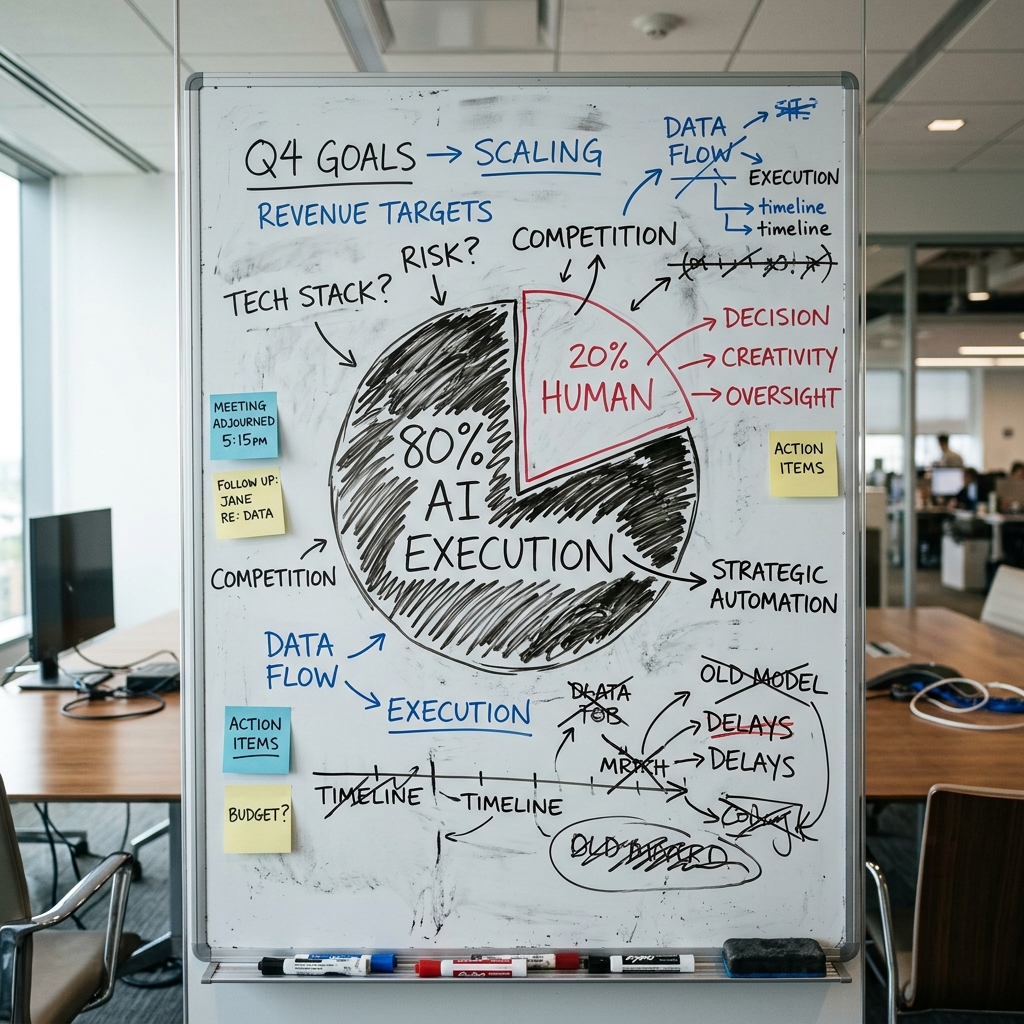
Can AI replace a marketing team? For most 7-8 figure businesses, AI can handle roughly 80% of marketing execution: content production, ad optimization, reporting, email sequences, and audience research. The remaining 20% still needs human judgment: brand positioning, client relationships, creative direction, and decisions that require reading a room. A 2024 McKinsey survey found that companies using AI in marketing reported a 10-20% reduction in marketing costs alongside revenue gains. That does not mean you fire everyone. It means you rebuild how the team works.
Why This Question Matters Right Now
Three years ago this was a hypothetical.
Today it is a budget meeting.
Business owners are looking at $15,000 a month in agency retainers and asking whether a $500 AI stack could do the same job. Some of them are right to ask. Some of them are going to cut the wrong things and wonder why growth stalled.
So here is the honest answer, based on what we actually see running AI marketing systems inside 7-8 figure businesses.
What AI Can Actually Do in Marketing (In Plain English)
This is where most articles lose you. They list features instead of telling you what changes in your business.
Here is what changes.
Content production. A business that used to publish two blog posts a month can publish eight. A team that struggled to write ad copy now generates 30 variations in an afternoon and tests them in the same week. At Talk To Your CMO, we've seen content output increase three to four times within the first 60 days of installing an AI system, without adding headcount.
Ad optimization. Tools like Shido read your ad account data continuously. They flag underperformers before you would have spotted them manually, suggest budget shifts based on actual numbers, and catch the kind of slow bleed that used to go unnoticed until the monthly review. An ad set draining $200/day with no conversions, for example, gets flagged before it becomes a $6,000 problem. Marketing metrics that actually matter get surfaced in real time instead of buried in a spreadsheet.
Reporting and diagnostics. Your team spends less time building slides and more time acting on the numbers. AI pulls the data, identifies the patterns, and tells you what is working and what is not. The decision still belongs to you.
Email and nurture sequences. AI writes, tests, and optimizes. Segmentation that used to take a junior marketer two days now runs automatically.
Audience research. Competitive analysis, trend identification, customer language mining from reviews and forums. Work that used to take a week now takes an afternoon.
All of that is table stakes now. It is not impressive. It is just what the baseline looks like in 2026 for businesses running AI in marketing properly.
What AI Cannot Do (The Honest Part)
AI is very good at executing on a clear brief.
It is bad at writing the brief.
Here is what still needs a human in the room.
Brand positioning. Deciding what your business stands for, who it is for, and what story you are telling the market is not something you hand off to a language model. AI can help you articulate it once you have decided. It cannot decide for you.
Reading context. A political event happens. A competitor has a public crisis. A product launch from someone in your industry changes the conversation. AI does not pick up on these shifts in real time the way a sharp marketer does. Someone needs to be watching the market and deciding when to pivot.
Relationship-driven marketing. Partnerships, referrals, community building, podcast appearances, joint ventures. These are still human. AI can help you prepare, research, and follow up. The relationship itself is still yours to build.
Creative leaps. AI is a very good remixer. It learns from what exists. The genuinely new idea, the campaign concept that no one has tried before, the message that stops someone mid-scroll because it is unexpected... that still comes from a person who has lived the problem.
High-stakes judgment calls. Pricing changes, market repositioning, entering a new segment. These decisions carry real risk. You want a strategist who has lived the consequences of getting them wrong. AI has seen patterns in data. That is a different thing.
In the accounts we manage, the businesses that get AI wrong are the ones that treat it like a replacement for thinking. The ones that get it right treat it like a very capable operator who needs clear direction.
AI vs Human Marketing Team: A Direct Comparison
| Task | AI | Human |
|---|---|---|
| Writing ad copy variations | Fast, scalable, needs editing | Slower, more original |
| A/B test management | Continuous, automated | Periodic, manual |
| Campaign performance reporting | Real-time, consistent | Weekly or monthly |
| Email sequence writing | High volume, needs brand check | Fewer but more nuanced |
| Brand positioning | Can articulate, cannot decide | Owns the decision |
| Competitor monitoring | Pattern detection, data-based | Context and judgment |
| Client/partner relationships | Cannot replicate | Irreplaceable |
| Creative strategy | Remixes existing ideas | Can generate genuinely new angles |
| Crisis response | Slow to adapt | Immediate human judgment |
| Budget allocation decisions | Flags signals, models scenarios | Makes the call |
The pattern is consistent. Execution tasks move to AI. Judgment tasks stay human. The more your team is spending time on execution, the bigger the immediate win from AI. The more your team is spending time on judgment, the less AI changes your headcount.
The Real Structure of an AI-Powered Marketing Function
Forget the robots-replacing-humans image. That is not what this looks like in practice.
The setup that works is simpler than most people expect: one strategist, AI handling most of the output, and the business owner staying close enough to steer.
A typical setup we install at Talk To Your CMO looks like this:
One senior strategist sets direction, owns positioning, manages client-facing relationships, and makes judgment calls.
AI handles content production, ad copy generation, reporting, email sequences, audience research, and performance monitoring.
The business owner reviews strategy monthly, approves positioning changes, and stays close to the numbers without building the reports.
That is it. Three layers. The output of this setup often exceeds what a full in-house team was producing, at roughly 30-40% of the cost.
If you are currently doing your own marketing or running with an agency retainer, the math on this shift is usually significant.
How Does AI Compare to a Marketing Agency?
This is the question most 7-8 figure business owners are actually asking.
They are not comparing AI to an in-house team. They are looking at a $10,000-$20,000 agency retainer and asking whether AI changes the equation.
Here is the honest breakdown.
What an agency gives you: A team of people, usually across strategy, creative, media buying, and account management. The quality varies enormously. The best agencies are worth every dollar. The median agency is billing you for junior staff time and calling it senior strategy.
What AI gives you: Consistent execution, 24/7 availability, no account handoffs, and output that scales without billing you for every hour. What it does not give you is someone who has seen your industry for 10 years and knows what you are missing.
The combination that works best right now: a strategist who understands your market, AI handling execution, and you staying in the loop on positioning. That is what an AI CMO installation is designed to do.
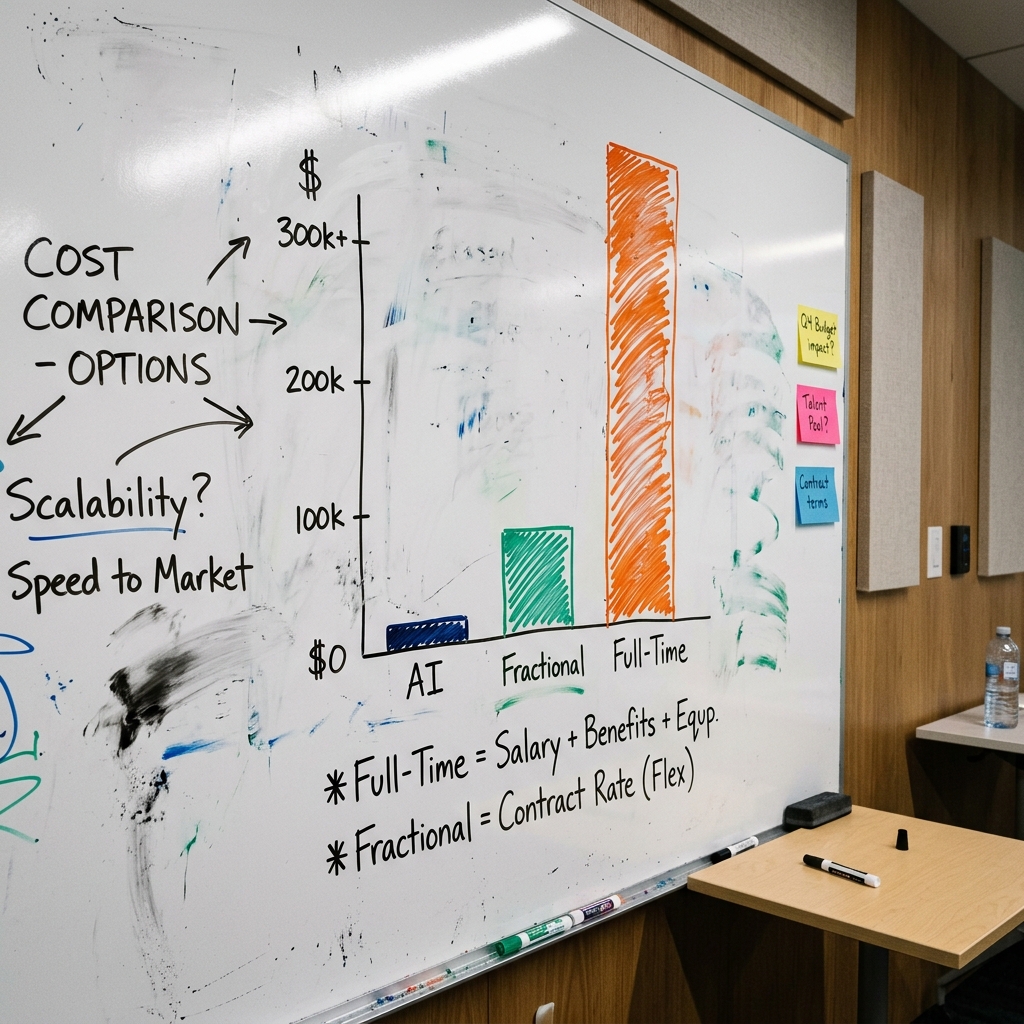
You can also look at how this compares to other hiring models in the AI CMO vs fractional CMO vs full-time CMO breakdown.
The Belief Most Business Owners Get Wrong
The common assumption is: "I need a marketing team to grow."
That assumption made sense in 2018.
What actually drove growth was having the right thinking, the right message, and enough execution capacity to test and iterate quickly. A team was the only way to get that execution capacity at scale.
AI changes the execution half of that equation. You still need the thinking and the message. You need significantly less human time to turn that thinking into content, campaigns, and optimized ad sets.
So the belief worth updating is not "I do not need any humans." It is: "I need fewer humans doing more strategic work, and AI handling the rest."
For a 7-8 figure business, that usually means going from a four-to-six person marketing function to one or two sharp people plus an AI stack. Output stays the same or improves. Cost drops 40-60%. Iteration speed goes up.
That is the actual shift. Not replacement. Compression.
What This Looks Like 12 Months From Now
Businesses that make this shift in 2026 will have a compounding advantage by 2027.
More content tested. More ad creative variations run. More data on what messaging works. More emails sent and optimized. More time for the strategist to think about positioning and growth instead of building reports.
Businesses that wait will be playing catch-up against competitors who have 18 months of AI-accelerated iteration behind them.
This is not a warning. It is just the math. An AI CMO system is not a one-time tool. It compounds. Every test run, every ad set optimized, every piece of content published builds a clearer picture of what moves the needle for your specific business.
The business owners who understand this are not asking "can AI replace my marketing team?" They are asking "how do I restructure my marketing function around AI to move faster?"
That is the right question.
Frequently Asked Questions
Can AI replace a marketing manager?
AI can replace most of the execution work a marketing manager does: writing briefs, scheduling content, pulling reports, managing ad variations, and tracking performance. What it cannot replace is the judgment, relationship management, and strategic thinking that a strong marketing manager brings. In practice, most businesses end up with one senior marketing person working alongside AI tools rather than eliminating the role entirely. The scope of the role shifts from execution to oversight and strategy.
Will AI replace marketing agencies?
AI will put significant pressure on agencies that sell execution, particularly those charging premium retainers for work that AI now handles faster and cheaper. Strategy-focused agencies, creative agencies with genuine original thinking, and specialist agencies in complex B2B sectors are more insulated. The agencies most at risk are mid-market generalists billing junior hours at senior rates. Many business owners are already moving retainer budget toward AI stacks plus a single strategist. The shift is happening now, not in five years.
What percentage of marketing can AI automate?
Based on what we see across the accounts we work with, AI handles around 70-80% of marketing execution for most 7-8 figure businesses. This includes content production, ad copy, email sequences, performance reporting, and audience research. The remaining 20-30% covering brand positioning, high-stakes decisions, relationship-driven growth, and genuine creative strategy still requires human judgment. McKinsey's 2024 research on AI in business functions puts the automation potential for marketing tasks at roughly 75%, consistent with what we observe in practice.
How much does it cost to replace a marketing team with AI?
A typical AI marketing stack covering ad monitoring, content production, email automation, reporting, and research runs between $500 and $2,000 per month in software costs. Add one senior strategist at $3,000-$6,000 per month and you have a full function for under $8,000. Compare that to a four-person in-house team at $25,000-$40,000 per month in salary and benefits, or an agency retainer at $10,000-$20,000 per month. The cost reduction is real. The key variable is finding one strategist who can work effectively with AI tools and who understands your business deeply enough to set the right direction.
Is now the right time to shift to AI marketing?
For most 7-8 figure businesses, yes. The tools are mature enough to deliver real output, the cost savings are immediate, and the competitive advantage of moving early is real. The businesses we see hesitating are usually waiting for a perfect moment that is not coming. The practical risk of moving now is low. Install the systems, keep one sharp strategist, and iterate. The risk of waiting is watching competitors compound 18 months of AI-accelerated marketing while you run the same playbook from 2022.
Benjamin Chew is the founder of Talk To Your CMO and the creator of the AI CMO Installation system. He has managed over $10 million in ad spend across ecommerce and service businesses throughout Southeast Asia and Australia.