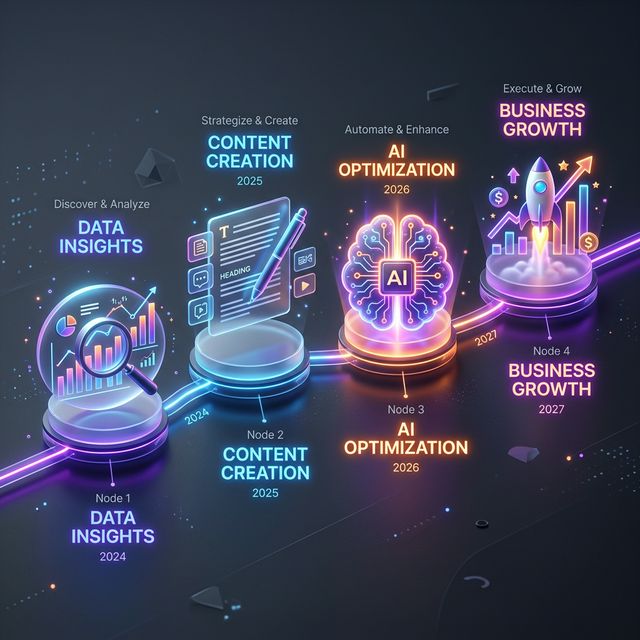

AI marketing automation is the process of using AI agents to handle repetitive marketing tasks, including content creation, ad monitoring, SEO, email, and reporting, without constant human input. In the businesses we work with at Talk To Your CMO, properly set-up AI marketing systems handle around 80% of the weekly marketing workload. According to McKinsey's 2025 AI Index, companies that scaled AI automation reported an average 22% reduction in operational costs and a 19% increase in revenue within 18 months. The setup takes days, not months.
Two years ago, "automating your marketing with AI" meant one thing: you bought a tool, connected it to your email list, and set up a drip sequence. That was it. That was the automation.
Everything else still required humans. Someone to write the content. Someone to check the ads. Someone to figure out what to post next week. Someone to turn the data into a decision.
So when people hear "automate your marketing with AI" now, most of them picture the same thing. A fancy email scheduler. Maybe some chatbot. Useful, sure. But not the thing that actually changes how much time you spend on marketing every week.
Here's what's different now.
AI agents in 2026 can carry out multi-step tasks on their own. Check your ad performance, spot a problem, diagnose the cause, and hand your team a fix... all before you've had your first coffee. Research keywords, draft a blog post targeting real search demand, and drop it in your content queue for review. Monitor your SEO rankings daily and flag the pages that need updating. Run your weekly social calendar without you deciding what to post.
That's a different category of thing. And the businesses that figure this out first are building a compounding lead on everyone who's still doing it manually.
What Does "Automating Marketing With AI" Actually Mean?
AI marketing automation means putting AI agents in charge of the execution layer of your marketing. The parts that eat your time but don't actually require your brain.
The old model of marketing automation (email sequences, scheduled posts, triggered workflows) handled the delivery of marketing. The message still needed a human to create it, the strategy still needed a human to decide it, and the performance still needed a human to review it.
AI agents handle all of that. They don't just deliver what you tell them to deliver. They create the content, monitor the performance, interpret the data, and tell your team what to do next. They're doing the thinking work, not just the sending work.
At Talk To Your CMO, we install these systems into businesses doing $15K to $150K a month in revenue. The pattern is consistent: within 30 days, the business owner is spending 2 to 4 hours a week on marketing instead of 15 to 20. The marketing doesn't slow down. It gets more consistent.
So here's the short version: you go from being the person who runs the marketing to being the person who approves it. The AI does the running.
What Can You Actually Automate This Week?
Forget the 12-month roadmap. These are things you can set up and have running within days.
Content Creation and Planning
AI agents can research what your audience is searching for, draft blog posts targeting those terms, plan your social media calendar, and write the posts, all based on real data from your business. You review. You approve. You publish.
The drafts won't be perfect the first week. They will be by week three. Every edit you make trains the system. Most business owners find the edits drop by 80% within the first month.
Ad Performance Monitoring
Your ads need someone watching them every day. Most businesses only find out something broke during the weekly agency call, which means they burned three to five days of budget on a dead ad set before anyone noticed. An AI agent catches it the same day. It flags the problem, gives you the likely cause, and tells your team exactly what to adjust. We cover the diagnostic method behind this in detail in how to tell if your ads are actually working.
SEO Monitoring and Content Updates
Rankings change. Pages that hit page one in January can slip to page two by March. An AI agent tracks this every day. When a page starts dropping, it surfaces the page, identifies what changed, and drafts an updated version. Most business owners don't have anyone doing this. The rankings just erode quietly.
Email Sequences and Follow-Up
Lead comes in. Sequence starts. Follow-ups send on schedule. The content inside those emails can be personalized based on what the lead did, what they clicked, how they responded. None of this needs human hands on it once it's set up.
Weekly Reporting
Instead of spending two hours pulling data together every Friday, the AI pulls the report, highlights what moved, and tells you what to pay attention to. You read it in ten minutes. You make the call. Done.
What to Automate vs. What to Keep Human
This is the table most guides skip. The goal isn't to automate everything. Some things still need a human, and trying to automate them badly is worse than not automating at all.
| Marketing Task | Automate It | Keep Human |
|---|---|---|
| Blog post drafting | AI researches + writes first draft | Human reviews, adds real stories |
| Social media scheduling | AI plans calendar + writes posts | Human approves before publish |
| Ad performance monitoring | AI flags issues daily | Human makes the spend decision |
| Email sequences | AI writes + sends | Human checks tone quarterly |
| SEO keyword research | AI finds opportunities | Human picks which to prioritize |
| Reporting | AI pulls data + flags trends | Human decides what to act on |
| Brand voice and positioning | Never automate | Always human |
| New channel strategy | Never automate | Always human |
| Client relationships | Never automate | Always human |
| Real stories and case studies | Never automate | Always human |
The pattern is clear. Automate the execution. Keep the judgment. The AI is fast and never forgets. You have the context and the lived experience the AI will never have.
How to Set Up AI Marketing Automation Step by Step
Step 1: Connect Your Data
The AI needs to see what's happening in your business before it can do anything useful. Connect your ad accounts (Meta, Google Ads), Google Search Console, your email platform, and your social accounts. This takes a few hours the first time. Once it's connected, the AI has a live feed of your marketing performance.
Without the data connection, the AI is guessing. With it, everything it produces is grounded in what's actually happening in your business.
Step 2: Build the Context Layer
This is what most people skip and then wonder why the AI output sounds generic. You need to give the system your brand context: who your customer is, what you sell, how you talk, what your positioning is, what makes your business different.
Think of the context layer like an onboarding document for a new team member. Except this team member reads it once and never forgets it. The more specific you are here, the less editing you'll do later. At Talk To Your CMO, we build this as a structured document during the first week of every installation.
Step 3: Start With One Channel
Pick the channel that wastes the most of your time right now. For most businesses, that's content. For others, it's ad monitoring. Pick one, get the AI running on it, and let it run for two weeks before you add anything else.
The temptation is to automate everything at once. The problem with that is you end up with half-built systems on five channels instead of one channel working well. One channel working well will save you four to six hours a week immediately.
Step 4: Set Up the Review Loop
You still review output before it goes out. The AI drafts, you approve. The review loop is what keeps the AI getting better. Every time you make an edit, you're training the system. If you skip reviews and just let it publish whatever, you lose the feedback loop and the quality plateaus.
The review loop doesn't take long. Most business owners spend 20 to 30 minutes a day in the first two weeks, then drop to 15 to 20 minutes once the AI has learned their voice. After 30 days, a lot of content is going from draft to approved without any changes.
Step 5: Expand Once the First Channel Is Running Well
Week 3, add the second channel. Week 5 or 6, add the third. By month two, you have a full marketing operation running on AI with you spending a fraction of the time you used to.
The compounding starts here. Each channel you add feeds data into the others. The blog posts inform the social content. The social performance informs the SEO priorities. The ad data informs the email sequences. The system starts to feel like a real marketing operation because it is one.
How Long Does It Take to See Results?
Week 1: Setup and data connection. The AI is learning your business.
Week 2: First content drafts. Heavier editing. You're training the system.
Week 3: Edits drop significantly. Content starts looking like you wrote it. Monitoring is active on all connected channels.
Month 2: You're saving 10 to 15 hours a week. First SEO content is indexed and starting to rank. Ad issues are being caught same-day instead of end-of-week.
Month 3 to 6: The compounding shows up. Blog traffic builds. Social consistency compounds. Ad performance improves because nothing is slipping through the cracks. The AI knows your business well enough that new campaigns require less briefing every time.
85% of marketers using AI report saving at least four hours per week. The businesses we install full AI CMO systems into save significantly more than that because the system covers every channel, not just one tool.
What AI Marketing Automation Still Can't Do
The AI can't replace the human layer entirely. Anyone who tells you it can is selling something.
The AI doesn't know you just closed your biggest client. It doesn't know your product roadmap changed. It doesn't know the conversation you had with a customer last Tuesday that changed how you think about your market. It doesn't know your co-founder just left and the positioning needs to shift.
All of that is yours. The AI operates on the information you feed it. When the information is current and specific, the output is excellent. When the information is stale, the output drifts.
So the human role is keeping the AI fed with real context. New stories. New data. New positioning decisions. Real client wins and losses. The businesses that run this well spend about 30 minutes a week on that input. The AI handles everything else.
The bigger question of whether AI can fully replace a marketing team is one we cover directly in Can AI Replace Your Marketing Team?.
What Does AI Marketing Automation Cost?
The range is wide because "AI marketing automation" covers a lot of ground.
At the entry level, you can string together a few AI tools (an AI writing assistant, a scheduling tool, a simple analytics alert) for $100 to $300 a month. You'll save a few hours a week and get inconsistent output because the tools don't talk to each other.
A fully installed AI CMO system, where all the channels are connected, the AI knows your business, and there's a real feedback loop running, costs under $50,000 a year. That includes strategy and execution. Compare that to a fractional CMO at $72,000 to $180,000 a year, or a full-time CMO hire at $250,000 to $800,000.
The ROI math is obvious. We break down the full comparison in What Is an AI CMO.
For most businesses doing $15K to $150K a month in revenue, the right entry point is starting with one or two AI tools connected to your biggest time drain, then expanding to a full system once you've seen what's possible. Read how to interpret your ad data to understand the monitoring layer before you automate it.
Frequently Asked Questions
How do I start automating my marketing with AI if I have no technical background?
Start with a single tool that connects to something you already use. An AI writing assistant for your blog, or an AI monitoring tool for your ads. You don't need to code anything. Most AI marketing tools are set up through a dashboard with no technical skills required. The key is to pick one problem (usually content creation or ad monitoring), solve it with one tool, and get the workflow running for two weeks before adding anything else. Once that first piece is running, it gets easier to see where to add next.
What is the difference between AI marketing automation and regular marketing automation?
Regular marketing automation (tools like Mailchimp, HubSpot) follows rules you set in advance. If someone clicks this link, send this email. It executes your instructions. AI marketing automation makes decisions on its own. It can look at your ad performance and identify which ad set to pause without you telling it to check. It can identify which keywords to target based on current search data without you briefing it. The difference is rule-following versus decision-making. Both are useful. AI automation handles far more of the marketing workload because it can think, not just execute.
Can a small business with no marketing team automate marketing with AI?
Yes, and this is actually where AI marketing automation has the biggest impact. When there's no marketing team, the business owner is doing everything manually, which means marketing only happens when there's time, which means it never happens consistently. AI agents don't need a team around them to function. They run on their own schedule, produce output daily, and only need you for final approval. A lot of the businesses we work with at Talk To Your CMO are solo founders or two-person operations running a full marketing function through AI. You set the direction. The AI does the work.
How much of my marketing can I realistically automate with AI?
In our experience, around 80% of the weekly marketing workload can be automated within the first 90 days of a properly installed system. That covers content drafting, social media scheduling, ad monitoring, SEO tracking, email sequences, and reporting. The 20% that stays human is the judgment layer: positioning decisions, new story inputs, relationship-building, and strategic direction. The goal is not 100% automation. The goal is freeing your time from the execution work so you can focus on the 20% that actually requires your brain. What an AI CMO does week by week shows you what the full split looks like in practice.
How do I know if my AI marketing automation is actually working?
Watch three things. First, time saved: are you spending fewer hours on marketing tasks this week versus four weeks ago? Second, consistency: is content going out on schedule without you manually pushing it? Third, performance trends: are your SEO rankings, ad costs, and engagement metrics moving in the right direction over 60 to 90 days? A system that's working shows up in all three. If time is saved but performance drops, the quality control needs tightening. If performance is fine but you're still spending 15 hours a week on marketing, the automation isn't covering enough ground. Both numbers need to move.
A year from now, most of your competitors will still be running marketing manually. Same cycle: write content when there's time, check ads when something breaks, wonder why growth is inconsistent.
The businesses setting up AI marketing automation now are building something different. Every week the AI runs, it learns more about the business. Every piece of content it publishes builds more search visibility. Every ad set it monitors catches problems before they become expensive.
That gap compounds. And it starts with just setting up the first piece.
If you want to see what this looks like installed into your specific business, book a strategy call and I'll walk through your channels and where the automation makes the most sense to start.